How do we teach bioinformatics to 10,000 students at the same time?
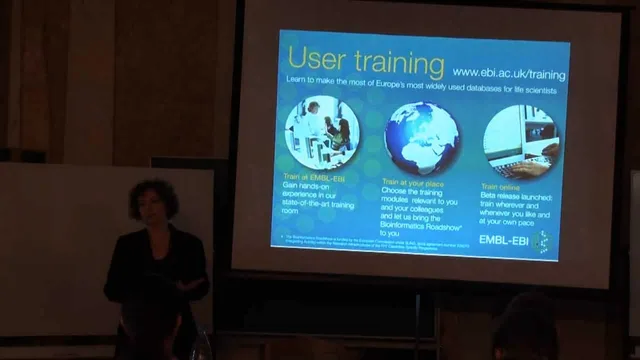
The shape of education is changing from strictly classroom-based learning to encompassing online learning, either as auxiliary learning tools or as a complete learning environment in its own right. Finding that hands-on training, while very useful, does not meet the demand for courses, the European Bioinformatics Institute has developed a Train-on-line site to provide a series of bioinformatics courses to a wider audience. Online learning can be particularly useful for bioinformatics courses, where students often have diverse backgrounds, as it permits students with similar learning needs to link-up. The EBI plans to promote this through the use of subject-focused online Forums, where experts will be able to link directly with groups of students.
To be successful, online learning needs good visibility. One approach is to connect with the efforts of Wikipedia, Wikiversity and Wikibooks. EBI online courses link glossary terms to Wikipedia, and plan to link terms back from Wikipedia to online courses, such as to modules covering EBI databases that have entries in Wikipedia. Courses can also be place on Wikiversity for greater accessibility to the public.
A second major change in the education system is an online environment for teachers, where they can share materials thereby improving the quality of classroom-based learning and helping to provide education standards. The Bioinformatics Training Network is one such site, a community-based project that aims to provide a centralised facility to share materials, to list training events (including course content) and to discuss training experiences. The site was developed and is maintained by those active in the field of bioinformatics education from any country worldwide.
Информация о лекции с сайта RECOMB Satellite Conference on Bioinformatics Education
- АвторJennifer McDowal
 ОрганизаторComputer Science клуб при ПОМИ РАН
Лекции курса
9- Bioinformatics Learning 2.0: proposing an open source consortium for bioinformatics teaching materialsChristopher Lee
- From Sequence to Structure and Function: Inspiring Students with Bioinformatics ProblemsBrian Tjaden
- The Number of Reversing SubstitutionsСергей Науменко
- How do we teach bioinformatics to 10,000 students at the same time?▶ Вы тут
- Estimating the statistical significance of sequence motifsUri Keich
- Machine learning methods for protein sorting predictionHenrik Nielsen
- Evolutionary History of RepeatsСергей Николенко
- Identifying the Microbiomic Basis of DiseaseGabriel Valiente
- Alignment Beyond Sequences: Forwards and Backwards in Colors and DAGsMichael Brudno